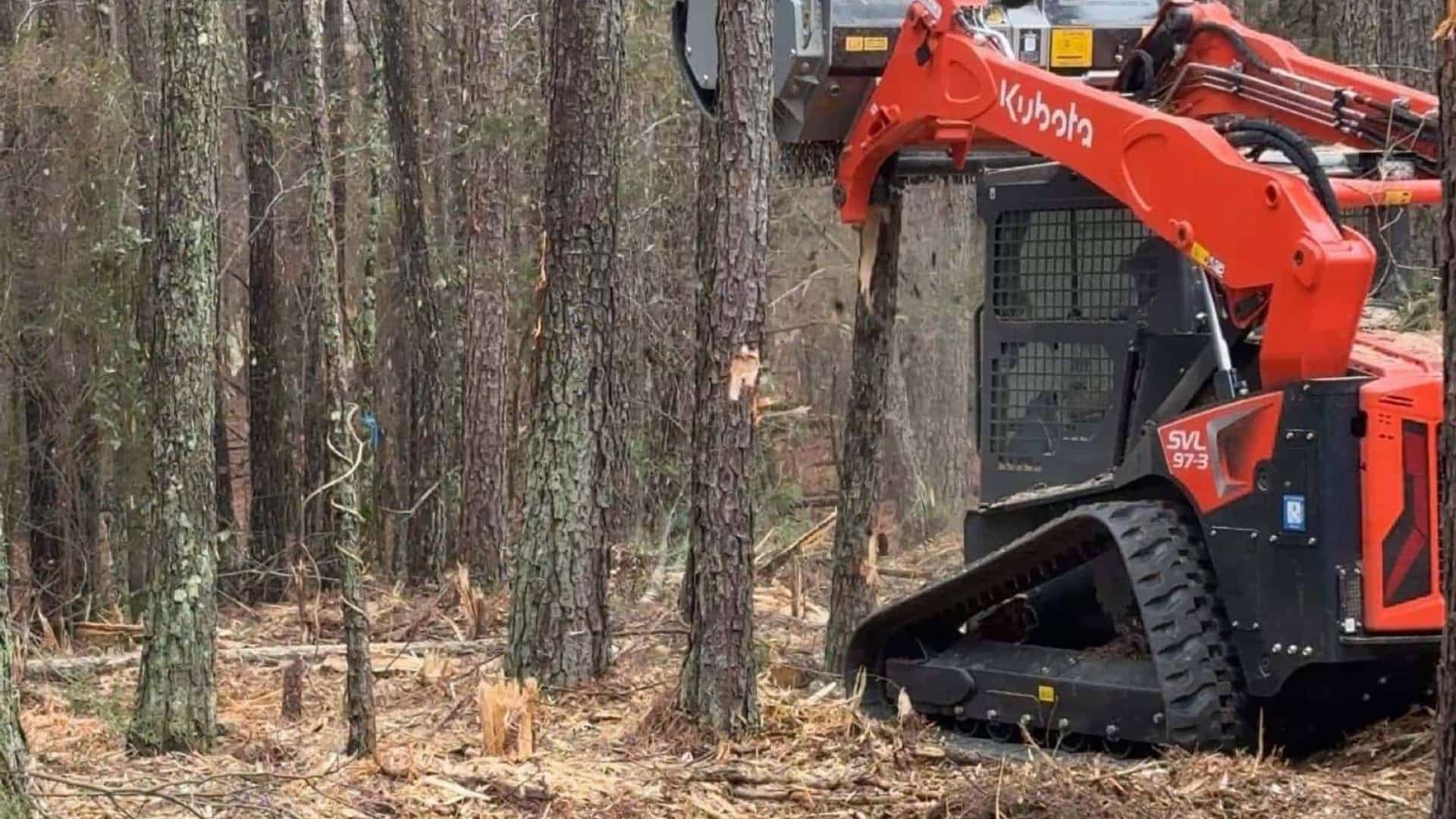
Right after "how much does it cost," the question we get most is "how long is this going to take?" People want to know if we're talking a day, a week, or something that drags on all month. The honest answer is that it depends almost entirely on how thick the growth is — but after running our machine across hundreds of Carolina acres, we can give you real numbers instead of a shrug.
Here's how we think about timing on a forestry mulching job around Rock Hill and York County, and what makes one acre take three hours and the next one take two full days.
The short answer: about half an acre to two acres a day
On a typical residential job, we clear somewhere between a half-acre and two acres in a single day with one machine. Light brush, saplings, and briars go fast. A pasture that's grown up for two or three years with mostly soft material can move at close to an acre every few hours. A woodlot packed with 6- to 8-inch hardwoods, heavy vines, and standing deadfall is the slow end — that might be half an acre in a day.
So a standard one-acre overgrown lot in Rock Hill or Fort Mill is usually a one-day job. Two to five acres is generally two to four days depending on density. We run a Kubota SVL 97-3 with an FAE mulching head, and that combination is built to keep moving all day rather than overheat and stall out on the thick stuff.
What actually slows a job down
Tree diameter is the biggest one. Grinding a two-inch sapling takes seconds. Grinding an eight-inch hardwood takes real time because the mulcher has to chew it down in passes. A lot full of big stems is simply slower than a lot full of brush, even if the acreage is identical.
Density is next. Two acres of scattered growth clears faster than one acre of wall-to-wall privet and vines with no gaps. When you can barely walk through it, the machine is working every second, and that takes longer per acre.
Terrain and moisture matter too. Slopes, ditches, and our York County red clay after a hard rain all slow access and force us to work carefully so we don't leave ruts. And anything we have to protect — a fence, a septic field, trees you want to keep, a shed — means slower, more deliberate passes instead of open-throttle clearing.
How to estimate the time for your property
A rough rule of thumb for our area: figure one day per acre for heavy, wooded growth, and closer to a half-day per acre for lighter brush and saplings. If your property is a mix — some open pasture, some thick woodline — split it in your head and add it up.
Under a half-acre is almost always a same-day job, often just a few hours. The bigger the property, the more the per-acre time actually improves, because we're not repacking and moving the machine as often. Five acres doesn't take five times as long as one acre.
One pass and you're done — no cleanup week
The reason mulching feels fast compared to traditional clearing is that there's no second phase. There's no crew coming back to load debris, no trucks hauling to a dump, no burn pile smoldering for days. When the machine shuts off, the job is finished — the material is already ground into a mulch layer on the ground.
That's a big part of the time savings. A traditional clear-and-haul job on the same acre can stretch across a week once you count cutting, loading, hauling, and grading. Mulching collapses all of that into the hours the machine is running.
Get a real timeline for your job
The only way to know exactly how long your property will take is to have us walk it. We'll look at the density, the tree sizes, and the access, and tell you straight whether it's a half-day, a full day, or a multi-day job before we ever start the machine — so you can plan around it.
Call or text Corey at (803) 610-2249 for a free on-site quote. We're based in Rock Hill and cover all of York County — Fort Mill, Tega Cay, Lake Wylie, York, and Clover — plus Lancaster, Chester, Cherokee, and Union in SC and Mecklenburg, Gaston, and Cleveland in NC.