One of the most common questions we get before starting a land clearing job is: do I need a permit? The short answer is — it depends on where you are and what you're doing. South Carolina doesn't have a statewide tree removal permit, but your city, county, or HOA might have rules that apply.
Here's what we've learned from working across Rock Hill, Fort Mill, York County, and the Greater Charlotte area.
City of Rock Hill
Rock Hill has a tree ordinance that applies mainly to commercial development and subdivisions. If you're clearing land for a new home on a single residential lot, you typically don't need a specific tree removal permit — but you may need a land disturbance permit if you're grading or disturbing more than a certain amount of soil.
If your project involves any construction (new home, driveway, outbuilding), the building permit process usually covers the land clearing portion. Check with Rock Hill's Planning & Development department to confirm what applies to your situation.
York County (Unincorporated Areas)
If your property is in unincorporated York County — outside city limits — there's generally more flexibility. York County doesn't have a standalone tree removal ordinance for residential properties. However, if your property is near a waterway or in a flood zone, there may be buffer requirements that restrict how close to the water you can clear.
If you're clearing land as part of a development project, you'll likely need a land disturbance permit from York County Stormwater Management.
Fort Mill and Tega Cay
Fort Mill has tree preservation requirements tied to its development ordinances. If you're building in a new subdivision, tree canopy requirements may affect how many trees need to remain on the lot. For existing residential properties, clearing brush and undergrowth typically doesn't require a permit.
Tega Cay has similar provisions. The key is whether your clearing triggers a land disturbance threshold — usually tied to the amount of earth being moved or exposed.
HOA Restrictions
This is the one that catches people off guard. Even if the city or county doesn't require a permit, your HOA might have rules about tree removal, lot appearance, or modifications to your property. Some HOAs require written approval before any clearing work begins.
We always recommend checking your HOA covenants before scheduling work. It takes five minutes and can save you a lot of hassle.
What About Burning?
If you're considering burning debris (not something we do — forestry mulching eliminates the need), you'll need an open burning permit from the South Carolina Forestry Commission. Burn permits are free but seasonal, and there are restrictions on what you can burn, where, and when.
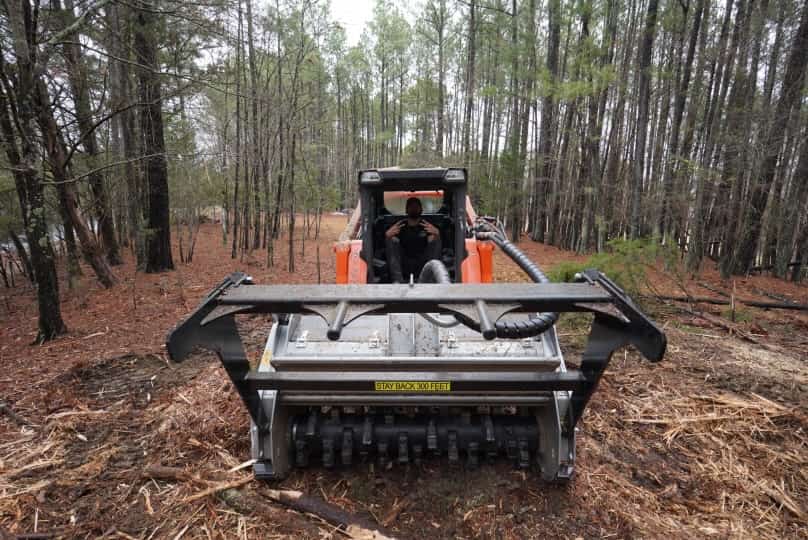
This is another reason forestry mulching is the easier option — no debris to haul or burn means no permits for disposal.
Charlotte and Mecklenburg County (NC Side)
If your property is across the state line in Charlotte or Mecklenburg County, the rules are stricter. Charlotte has a well-known tree ordinance that requires tree save plans for certain development projects. Residential properties generally have more freedom, but if your lot is in a tree conservation zone, you may need approval before removing protected trees.
Mecklenburg County also has stream buffer rules and a post-construction stormwater ordinance that can affect clearing projects near waterways.
How We Can Help
We've worked on hundreds of properties across both Carolinas, so we have a good feel for what's typically required in each area. While we're not a permitting service and can't give legal advice, we can point you in the right direction and let you know if your project is likely to need approvals.
If you're unsure, we'll help you figure it out during your free estimate. Just reach out — we're always happy to walk through the process.