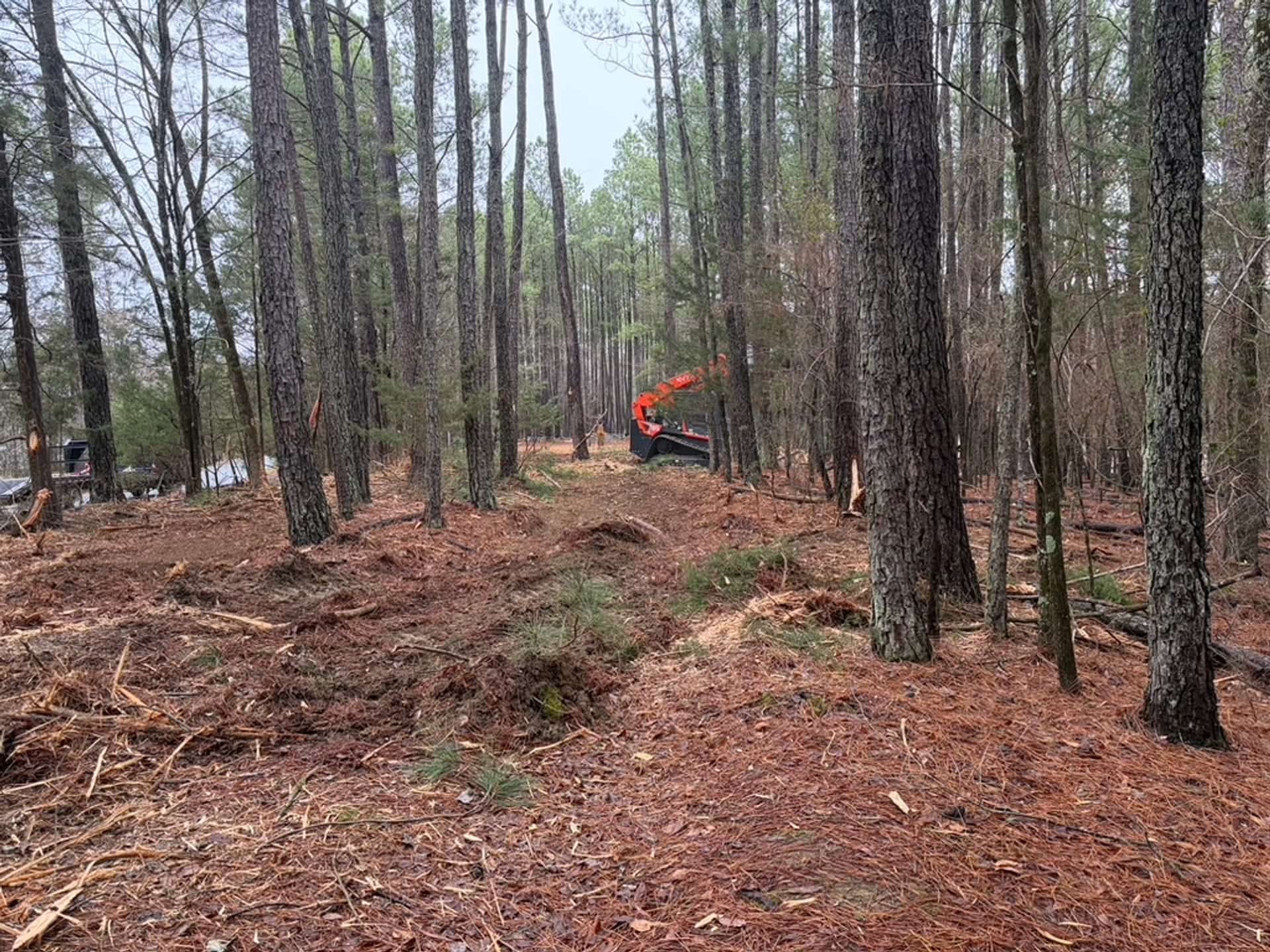
Great Falls sits in the eastern part of Chester County along the Catawba River, surrounded by thousands of acres of mixed pine and hardwood forest. It's prime hunting country — deer, turkey, and hogs all thrive out here. But managing hunting land means more than hanging a stand and hoping for the best. If your lease or private land is choked with underbrush, you're losing food plot space, visibility, and access.
A&S Brushworks works with hunting clubs and private landowners across Chester County to clear trails, open up food plots, cut shooting lanes, and generally make hunting properties functional. Here's how we approach it.
Food Plot Clearing
A food plot doesn't need to be huge — most effective plots for deer range from a quarter acre to two acres. But they do need to be clear down to soil level, with enough sunlight to grow clover, brassicas, or whatever you're planting. If the spot you picked has grown up in saplings and brush, forestry mulching is the fastest way to get it ready.
The mulcher grinds everything — small trees, brush, stumps, and roots near the surface — into fine chips. Those chips break down and add organic matter to the soil, which actually helps your food plot establish. After mulching, you'll typically need to disk or till the ground before seeding, but the heavy lifting is done.
We can clear plots in odd shapes to follow natural terrain features — creek edges, ridgelines, or existing timber lines. Irregular-shaped plots with cover nearby tend to attract deer during daylight hours better than big open rectangles in the middle of a field.
Shooting Lanes and Sight Lines
If you hunt from a stand and can't see more than 30 yards in any direction, you're missing opportunities. Shooting lanes don't need to be wide — 10 to 15 feet is plenty — but they need to be clear of brush, saplings, and low-hanging limbs that deflect arrows or obscure your line of sight.
We cut shooting lanes by running the mulcher along the path you designate. The result is a clean corridor at ground level with mulch laid down to prevent immediate regrowth. Most hunters want 2 to 4 lanes radiating out from each stand location, typically 50 to 100 yards long.
The key is doing this work well before season. Deer notice changes in their environment, and a freshly cleared lane will alter their patterns temporarily. Plan to have lanes cut at least 6 to 8 weeks before season opens so the area settles and deer get comfortable moving through it again.
Access Trails
Getting to your stands quietly matters as much as the stand placement itself. A trail beaten through heavy brush makes noise — you're snapping branches, crunching through deadfall, and alerting everything within earshot. A properly cleared access trail lets you walk in quietly, and it doubles as a route for hauling gear and dragging game out.
We clear access trails at 8 to 12 feet wide, which is enough for an ATV or side-by-side. If you only need foot trails, we can go narrower. The mulcher handles the entire corridor — ground-level brush, saplings, stumps that would trip you in the dark — and leaves a flat, walkable surface covered in mulch.
For larger properties around Great Falls, we've cleared trail networks of a mile or more connecting stand locations, food plots, and parking areas. A well-planned trail system makes managing the property easier year-round, not just during season.
Cost for Hunting Land Work
Hunting land preparation is priced the same as our other forestry mulching work — generally $1,500 to $5,000 per acre depending on vegetation density and terrain. But hunting jobs often don't involve clearing full acres. You might need a half-acre food plot, four shooting lanes, and a quarter-mile trail. We quote those jobs based on the actual scope of work.
A typical hunting property setup — one or two food plots, several shooting lanes, and a trail network — usually runs less than clearing the equivalent acreage outright because we're selectively clearing rather than taking everything down. We'll walk the property with you, mark out what needs to be cleared, and give you a firm number.
If you're splitting costs with a hunting club, it helps to have a plan before we come out. Know where you want your plots, where the stands are going, and how you want trails to connect. That way the estimate is accurate and the work gets done in one mobilization.
Timing and Scheduling
The best time to prepare hunting land is late spring through summer — well ahead of deer season. This gives food plots maximum growing time and lets the woods settle after clearing. We get the most hunting land calls between April and August, so booking early in the season gives you the best scheduling flexibility.
A&S Brushworks serves all of Chester County including Great Falls, Richburg, Fort Lawn, and Chester. Call us at (803) 610-2249 for a free estimate on your hunting property.
Looking for land clearing in Great Falls, SC?
View our Great Falls service page →