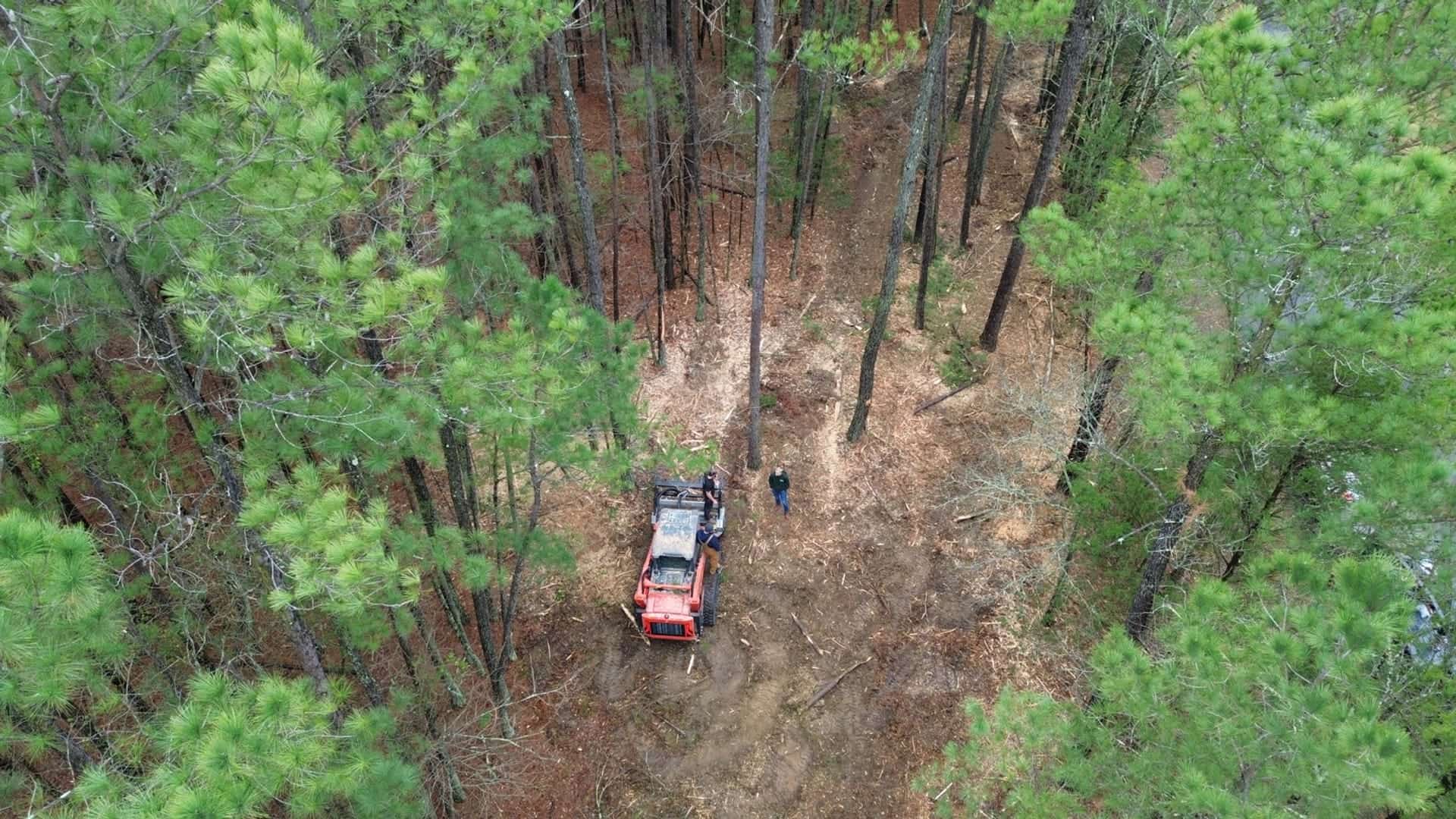
Kershaw sits in the northeastern corner of Lancaster County where rural land and timber tracts are a way of life. If you've had timber harvested recently — or even years ago — you know what's left behind: slash piles, stumps, damaged saplings, and a mess of tops and limbs scattered across the ground. It's not usable land until someone deals with that debris.
We work with landowners in the Kershaw area who need their cutover land cleaned up and brought back to a productive state. Whether you're replanting pines, converting to pasture, or just want clean acreage, forestry mulching is the most efficient way to get there.
What Timber Harvest Leaves Behind
Logging crews are in the business of getting merchantable timber out. They're not in the business of cleaning up afterward. What you're typically left with is a layer of slash — treetops, limbs, bark, and broken saplings — spread across the harvest area. Stumps are cut at whatever height was convenient for the faller, usually 6 to 18 inches above ground.
Within a year or two, the slash starts breaking down unevenly and aggressive regrowth moves in. Sweetgum, privet, and volunteer pines fill in fast. Vines cover the slash piles. What was an open timber tract becomes a tangled mess that's difficult to walk through, let alone manage.
Our Kubota SVL 97-3 with the FAE forestry mulching head is built for exactly this kind of work. It grinds slash, stumps, and regrowth into a uniform mulch layer in a single pass. The machine handles material up to 8 inches in diameter, which covers virtually everything left behind after a harvest.
Getting the Land Ready for Replanting
If you're planning to replant pines — which many Kershaw-area landowners do on a rotation — the ground needs to be in shape first. Planting crews can't work through slash and stumps. The ground needs to be accessible, reasonably level, and free of debris that would prevent seedlings from establishing.
Forestry mulching handles that prep work. The mulch layer left behind actually benefits new plantings: it holds moisture, moderates soil temperature, and suppresses competing weeds during the critical first year of growth. Compared to burning slash — which strips organic matter from the soil and can damage the top layer — mulching leaves the site in better condition for replanting.
We coordinate with landowners on timing so the mulching is done before planting season. For loblolly pine in this area, that usually means getting the site cleaned up by late fall so planting crews can get seedlings in the ground between December and March.
Converting Cutover Timber Land to Other Uses
Not every landowner replants after harvest. Some want to convert the land to pasture, food plots, or just clean acreage. Forestry mulching is the first step regardless of the end use.
For pasture conversion, mulching the slash and stumps gives you a surface that can be disked, seeded, and managed. The mulch layer breaks down within 6 to 12 months in our climate, blending into the soil. For food plots or wildlife management, the same principle applies — you need clean ground before you can do anything productive.
We've worked on properties in the Kershaw area where the landowner harvested timber, let the site sit for a few years, and then called us when the regrowth got out of hand. The sooner you address cleanup after harvest, the easier and more affordable the job is. Every growing season that passes means more material for us to grind through.
Pricing for Post-Harvest Cleanup
Post-harvest cleanup in the Kershaw area typically falls in the $1,500 to $4,000 per acre range depending on how much slash and regrowth is present. A recently harvested site with slash but minimal regrowth is on the lower end. A site that's been sitting for 3 to 5 years with heavy volunteer growth will be toward the upper end.
Larger tracts get better per-acre rates. If you're cleaning up 10 or 20 acres, the mobilization and setup costs are spread across more ground and the per-acre price drops. We'll give you a clear quote after walking the site — no guesswork.
Compared to the alternatives — hiring a dozer to push and pile slash, then burning it — forestry mulching usually comes in at a similar cost but with a much better result. No burn permits, no fire risk, no stripped topsoil, and the land is immediately ready for the next step.
Schedule Your Cleanup
If you've got cutover timber land in the Kershaw area that needs attention, the best time to deal with it is before another growing season adds to the problem. A&S Brushworks serves all of Lancaster County and we're familiar with the terrain and conditions around Kershaw.
Call us at (803) 610-2249 or reach out through our website for a free estimate. We'll come walk the site and give you a plan that fits your goals and budget.
Looking for land clearing in Kershaw, SC?
View our Kershaw service page →