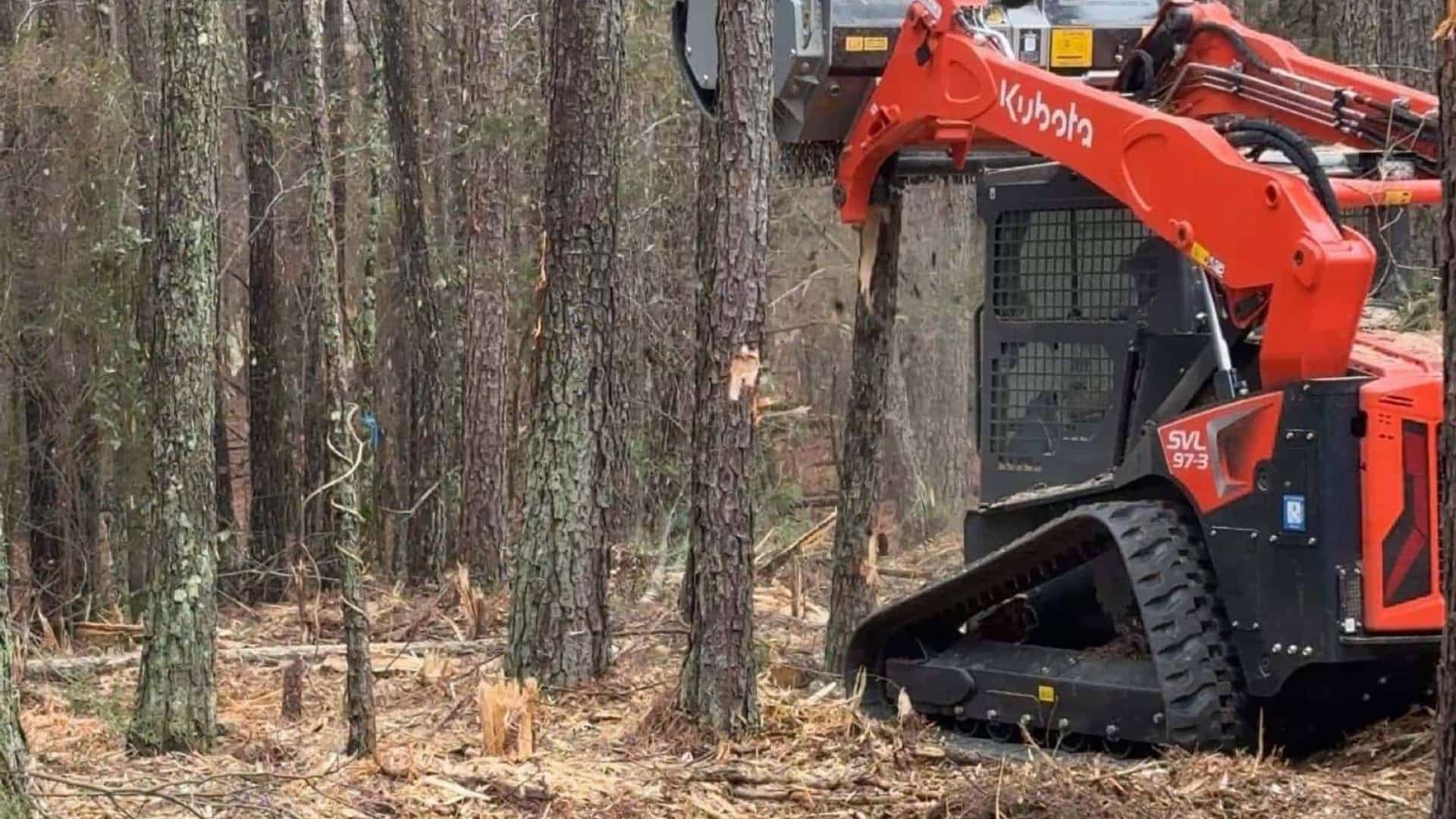
If you've never seen a forestry mulcher in action, the concept might sound unfamiliar. But once you understand what it does and how it works, it's easy to see why it's become the go-to method for clearing land across the Southeast.
Here's everything you need to know about forestry mulching — explained in plain language.
The Basic Idea
Forestry mulching is a land clearing method that uses a single machine to cut, grind, and clear vegetation in one pass. Instead of cutting trees down and hauling them away, a forestry mulcher grinds everything — trees, brush, stumps, and undergrowth — into small wood chips right where it stands.
The chips fall to the ground and form a natural mulch layer, typically 2–4 inches deep. There's nothing left to haul, burn, or clean up. The lot is clear and the ground is covered in a clean layer of organic material.
The Equipment
A forestry mulching setup typically consists of a compact track loader (like our Kubota SVL 97-3) fitted with a specialized mulching head (we use an FAE attachment). The mulching head has a high-speed rotating drum lined with carbide teeth that can chew through trees, saplings, brush, and stumps.
The machine is compact enough to navigate between trees you want to keep, work along fence lines, and access tight spaces that larger equipment can't reach. At the same time, it's powerful enough to handle trees up to 8–10 inches in diameter in a single pass.
What Can It Clear?
Forestry mulching handles most of what you'll find on an overgrown residential or light commercial property. That includes small to medium trees (up to about 10 inches in diameter), saplings, brush, thick undergrowth, vines like kudzu and honeysuckle, privet hedges, stumps at or near ground level, and fallen debris.
What it can't do: fell very large hardwoods (18+ inch diameter), remove massive root systems below grade, or handle rocky terrain where hidden boulders could damage the cutting head. For those situations, a combination of traditional equipment and mulching may be the best approach.
What Happens to the Mulch?
The ground-up material stays on your property. It's not waste — it's actually a benefit. The mulch layer suppresses weed regrowth so you're not fighting new growth within weeks. It prevents erosion by holding soil in place during rain. It retains moisture in the ground, which is good for any trees or plants you keep. And it decomposes naturally over 6–12 months, enriching the soil underneath.
Most customers prefer the look of a freshly mulched lot to bare dirt. It's clean, even, and natural-looking.
Common Uses
We see forestry mulching used for a wide range of projects. Overgrown lot reclamation — clearing neglected residential or vacant land back to a usable state. New home site prep — clearing a wooded lot before construction begins. Property line and fence line clearing — restoring visibility and access along boundaries. Trail and path creation — cutting recreational trails through wooded acreage. Easement maintenance — keeping utility and access easements clear. Pasture restoration — reclaiming fields that have been overtaken by scrub growth.
Why It's Popular in the Carolinas
The Southeast has an aggressive growing season. Leave a lot alone for a couple of years and it'll be covered in pine saplings, privet, and undergrowth. Forestry mulching is perfectly suited to this kind of vegetation — fast-growing softwoods and brush are exactly what the machine handles best.
The climate also means the mulch layer decomposes quickly, returning nutrients to the soil faster than in cooler regions. And since erosion is a real concern on Carolina red clay, having that protective layer is a big advantage over bare-earth clearing methods.
Is Forestry Mulching Right for Your Property?
If you have an overgrown lot, a wooded homesite, or any area covered in brush and small to medium trees, the answer is almost certainly yes. It's faster and more affordable than traditional clearing, better for the environment, and leaves a cleaner result.
The best way to know for sure is to have someone walk the property with you. We offer free estimates across the Rock Hill, York County, and Greater Charlotte area — just reach out and we'll set up a time to take a look.