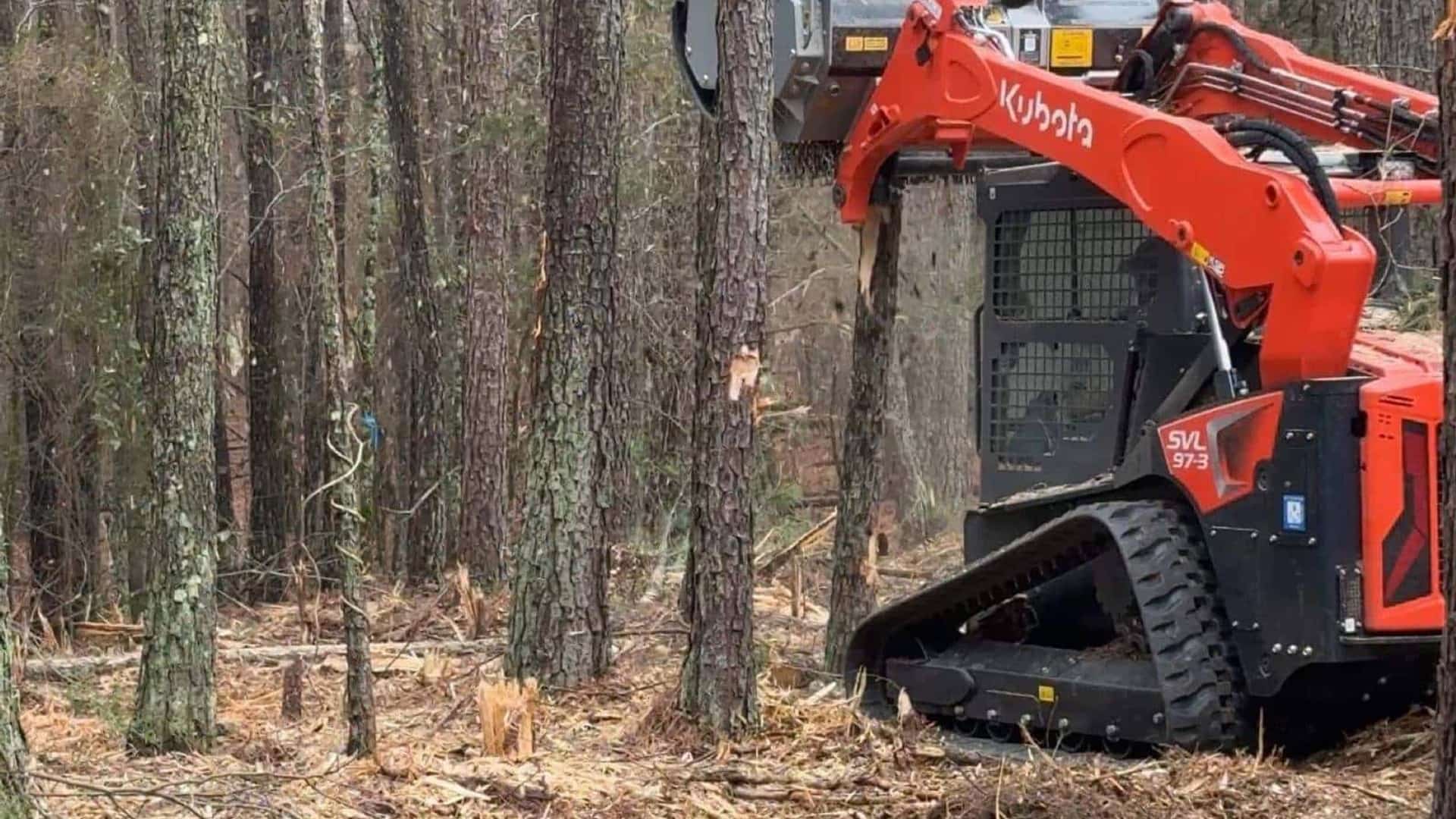
Most calls we get start the same way: "I need my land cleared." Then we ask what you want the land to look like when we're done, and the answer decides everything. Some people want the woods opened up and the trees they like left standing. Others want bare ground for a house, a driveway, or a pasture. Those are two different jobs, with different prices, timelines, and follow-up work.
This guide is about that choice: forestry mulching (grinding brush and small trees where they stand) versus full land clearing (taking trees and stumps out, raking up the roots, and hauling it all off-site so the ground is clear for what comes next). If you also want to know how mulching compares to a bulldozer or a bush hog as a machine, we cover that in Forestry Mulching vs Bulldozer vs Bush Hog.
The short version
- Choose forestry mulching if you want trails, fence lines, a view, a cleaned-up understory, or an overgrown pasture or lot brought back, and you're fine with ground that's covered in wood mulch with roots still in it. See our forestry mulching service.
- Choose full land clearing if you need a building pad, a septic or foundation area, a driveway cut, or a pasture with the stumps and roots out and hauled away. See land clearing and site prep.
- Some properties need a mix. We do mixed jobs: mulching in some areas (trails, fence lines, understory) and a full clear only where stumps and roots have to go. We also mulch buffer areas left around a full clear. We'll lay it out on the walk-through. Roots are only raked out on a full clear, never with mulching.
What each one actually is
Forestry mulching. A tracked machine with a rotary drum head grinds brush, briars, saplings, and small trees into mulch right where they stand. The mulch stays on the ground. Nothing is burned and nothing is hauled off. Roots are never raked out with mulching; they stay in the soil. Stumps stay too unless you ask us to grind them in place, which we can do case by case. Stump grinding is not something the mulcher does below grade as it goes.
Full land clearing. Trees are cut down and the stumps are pulled and hauled off-site. The roots are raked out and hauled off too. After that we do a rough grade. The result is bare, roughly graded ground with the stumps and roots gone. Finish grading, compaction, and excavation are separate work; tell us what your builder needs.
Decision guide: start with your goal
If you're torn, the question to ask yourself is: will anything be dug up or built on this ground in the next year? If yes, plan for clearing the footprint. If no, mulching usually gets you there for less.
| What you want | Usually the better fit | Why |
|---|---|---|
| Walking or ATV trails through the woods | Mulching | Cuts a path and leaves the rest standing. See trail clearing. |
| Fence line or property pins visible again | Mulching | Narrow corridor, minimal disturbance. Brush removal fits a lot of these jobs. |
| Open up a view, or a park-like look under mature trees | Mulching (selective) | You choose which trees stay. |
| Overgrown yard or lot brought back | Mulching | One pass, finished look. |
| Overgrown pasture (brush, briars, saplings) | Mulching | Bring it back to mowable ground. |
| Pasture where you'll run equipment or hay and want stumps and roots out | Full clearing | Stumps are hauled off and roots raked out only on a full clear. Mulching leaves them in the ground. Stump grinding in place is possible case by case. |
| House, shop, or barn pad | Full clearing (for the footprint) | Stumps and roots come out and get hauled off. We rough grade after the clear. Finish grading, compaction, and foundation work are for your builder. |
| Driveway cut | Often full clearing; mulching can open the corridor first | Depends on grade and surface. |
| Septic area, pond, or large grading project | Full clearing, then excavation by whoever is doing the dig | Soil has to move; that part is outside our rough-grade scope. |
| Trees larger than the mulcher can process on that site | Tree removal or full clearing | We look at the stems on the walk-through. There is no single diameter we publish. |
What drives the cost
We don't quote forestry mulching from a table, because every acre is different. Pricing depends on the site. Call or text (803) 610-2249 for a quote. The drivers below are the same ones in our forestry mulching cost guide.
Full land clearing runs about $8,000 to $10,000 per acre. That figure is for full clears only. It does not apply to forestry mulching or to mixed mulch-and-clear jobs, which we price after walking the property. Site conditions vary, so treat it as a starting budget for a full clear, not a quote.
- Vegetation density and tree size. Thick briars and privet are slower than open scrub. Bigger stems take more time.
- Acreage and what you actually want cleared. Selective work around trees you're keeping takes longer than an open corridor.
- Access and slope. A solid entry point and a gentle grade keep the job moving. Wet ground and steep slopes slow it down.
- Distance from Rock Hill. Farther jobs can carry a mobilization fee.
- Finish. Mulch left in place costs less than raking it, piling it, or hauling it off.
- Stumps and roots. On a full clear we haul stumps and raked roots off-site, which is the biggest reason full clearing costs more. Grinding a stump in place is a case-by-case option. The rough grade after a full clear is part of that job; finish grading is separate.
Erosion and soil: what the ground looks like afterward
Much of our area sits on Piedmont clay (red clay, in everyday terms) that washes easily on slopes. Mulching leaves a layer of wood mulch and the roots in place, which helps hold the surface. Mulch is not a guarantee against erosion, and tracked equipment can rut soft ground. Full clearing leaves bare, disturbed soil, so slopes and creek edges need real erosion control (silt fence, seeding, matting) until grass is established. If the lot slopes toward a neighbor, a stream, or a lake, tell us up front.
Timeline
Busy season is late spring through early fall, when vegetation is thickest. Winter and early spring are usually easier to schedule.
- Mulching: an acre with moderate brush is usually a day of machine time, and a few acres a few days. Our timing guide has more.
- Full clearing: the steps happen one after another (cut, pull stumps, rake roots, haul off, rough grade). Expect several times longer than mulching for the same acre, with weather delays at every step.
- Permits can add weeks on building jobs. See the section below.
What's left behind
- After mulching: a layer of wood mulch that breaks down over months. Stumps and roots still in the ground (we can grind stumps in place case by case). Selected trees still standing. You can walk it, mow it later, or plant through it.
- After full clearing: bare ground with stumps and roots hauled off, and a rough grade. You'll reseed or build from there. Finish grading is separate.
Follow-up work to plan for
- Regrowth. Mulching cuts growth; it doesn't kill roots. Stump sprouts and fast growers like privet and sweetgum come back, and a follow-up mowing or treatment keeps the land open. Details: Does forestry mulching kill trees? Will brush grow back?.
- Stump and root removal if you're building or want a smooth hay field. That means a full clear, since we only rake roots out on a full clear. We rough grade after a full clear; finish grading is separate.
- Seeding and erosion control after full clearing.
- Surveys, utilities, and drainage. Tell us about buried lines, septic fields, wells, fences, and drainage before we start.
Do I need a permit?
Possibly, and the rules are set by the county and the state, not by us. In both Carolinas the usual trigger for a stormwater or erosion-control permit is about one acre or more of land disturbance, including clearing and grubbing, or smaller sites that are part of a larger development. Some places also protect large trees, stream buffers, and lake shorelines. We can tell you what to ask, but you or your builder should confirm with the county before work starts. We do not promise that mulching alone does or does not count as land disturbance — that is the county's call.
County notes: York · Lancaster · Chester · Mecklenburg.
Not sure which one you need? Let's look at your land.
Tell us the town, the size, and the goal. We'll walk the property with you and tell you honestly whether mulching, full clearing, or a bit of both fits, even if that means pointing you to someone else for part of it.
Request a free quote · or call or text (803) 610-2249. Photos of finished work are in the gallery.
A&S Brushworks is owned and operated by Corey and Sam, based in Rock Hill, SC, serving York, Lancaster, Chester, Union, and Cherokee counties in SC and Mecklenburg, Gaston, and Cleveland counties in NC. Related work: trail clearing, easement clearing, and brush removal.
FAQ
Is forestry mulching the same as land clearing?
Land clearing describes the goal. Forestry mulching is one way to get there, and it fits many brush and understory jobs. Building sites often need extra work on top of it.
Can I build on land after forestry mulching?
Not by itself. Mulching clears the surface but leaves roots in the soil, and stumps stay unless they are ground in place case by case. If your builder needs stumps and roots out, that's a full clear. Talk to your builder before you book.
Is mulching cheaper than full clearing?
Usually, because there's no hauling or root raking. If you need stumps and roots out, that's a full clear and costs more. Forestry mulching is priced after we see the site. Full land clearing runs about $8,000 to $10,000 per acre, and that figure is for full clears only.
Will the mulch cause problems?
It breaks down on its own over months. If you want it raked, spread, or removed, say so when you request the estimate; that can change the price.
Does mulching stop erosion?
It helps cover the surface, but doesn't guarantee it. Slopes still need watching.
Can you leave the trees I want to keep?
Yes. Selective clearing around trees you're keeping is a common request. We mark them with you on the walk-through.
Which is faster?
Mulching, almost always.
How does this compare to a bulldozer or bush hog?
That comparison is about the machine. See Forestry Mulching vs Bulldozer vs Bush Hog. This guide is about the result you want: mulch left in place, or stumps and roots hauled off.
What should I send to get an estimate?
Your town or ZIP, approximate acreage, the vegetation, how we'd get the machine in, and what you want the land to look like. Photos help. Call or text (803) 610-2249.